Bowmore Tempest 2010 Edition

Bowmore Tempest 2010 is a 10 year old Scotch that is surprisingly easy drinking, yet due to its 56% alcohol level, will have you on the floor in no-time if you’re not careful. Being aged in first-fill ex-bourbon barrels, the flavours peak immediately and the peatiness adds extra richness to the drink. If you like a strong Scotch without the unpleasant burn, this one is definitely for you.

Bowmore Tempest is best had at the start of the night. It’s not heavy and with the exciting flavour profile, it is  bound to wake you up. Bowmore distillery is known for producing Scotches that have a strong and refreshing citrus flavour with a honey sweetness. This Scotch is no exception, though it has a higher intensity compared with its brethren. On the nose you’ll need to take a shallow breath to get past the sharpness of the alcohol, but soon enough you’ll get the scent of refreshing citrus, vanilla, green apples and some smokiness. On the pallet, more of those same flavours come through, but it is far smokier, with the addition of caramel notes, spice, and some oak. The lingering flavours are more bitter than sweet.

The Bowmore Temptest is $73.95 and at the time of writing this article there are quantities left, but the product has been listed as “discontinued.” This isn’t a surprise, as Bowmore only produces a limited amount of this style of Scotch. This is the second batch, and while the distillery may be releasing a third batch, it’s anyone’s guess if the LCBO will stock it.

Arran 10 Year Old

Arran Distillery is one of the newer distilleries in Scotland, having opened its doors in 1995. They’re a small-production family owned distillery, and they distinguish themselves by avoiding some of the industry ‘shortcuts’ commonly found in more mass-produced Scotches.

For example, many distilleries add caramel to give the liquid a richer, darker colour, as there is the belief that consumers associate better quality and taste with greater colour depth. Arran, on the other hand, does not artificially colour their whisky. Secondly, they do not use chilled filtration, another common practice used among some distilleries to create a richer and more vibrant colouring. Some in the industry believe that chilled filtration removes complexity from the drink as it filters out fatty acids and protein naturally occurring in the distillery process.

Arran originally broadly released a 12 year old drink which was well received, and has since been replaced with the 10 year old. Also commonly sold is the 14 year old as well as a cask strength scotch.

I’m really enjoying their 10 year old scotch, especially considering how affordable it is (just $49.95). On the nose there’s citrus, green apples, and you can practically taste the barley. On the pallet there’s a surprising amount of oak for such a young whisky, leading to a hint of smoke. This gives the dram nice notes of vanilla, allowing for the barley sweetness to come through.  It’s a silky smooth scotch that has a sharpness to its finish that’s quick and not too sweet.

Compared to the Singleton, featured previously in the Whisky Cabinet, I would say it has a similar sharpness but a deeper complexity in terms of finish. The Singleton has a dried fruit finish, whereas this is sharper and citrusy in a way that’s not too intrusive. At the price point you really can’t go wrong, though I would recommend a few sips to get past the sharpness before you settle into it. If you have another $30 laying around, the 14 year old is a good option at $79.95. You’ll get a fruitier drink that’s not as sharp, with more emphasis on spiciness.

Note: Originally published on Spotlight Toronto

Doing the Math on Whisky Pricing

When people talk about scotch, one of the main barriers frequently mentioned is the high price point. While a $40 bottle of Scotch is not too expensive, once you get in the $80 and $140 range things start adding up fairly quick. But the question is -  is $80 for a bottle actually expensive?

The thing to remember about scotch is that there’s no fermentation process within the bottle, and while Scotch will lose its flavour if left in a glass for hours, it will remain quite stable within the bottle. Your first and last glass of scotch will taste relatively the same, and a good bottle can sit on the shelf for years. (Sidenote: rarely do they last more than a few months at my home.)

A typical bottle is 750mL (though there are some that are 700mL) which has approximately 25 ounces of Scotch. Depending on your pour size (commonly between 1 to 1.5 ounces), you’ll get between 16 and 25 servings of scotch per bottle. This is compared to wine, which generally has just over four servings and lasts only for a few days once uncorked.

Being generous and using a 1.5 ounce pour as a basis, a bottle of scotch will give you four times the number of servings as a bottle of wine. Based purely on consumption, if you’re comfortable purchasing a $20 bottle of wine (or about $5 per serving), spending $80 for scotch is well within your range (the same price – $5 a serving). A thrifty 1 ounce pour brings you up to a $125 bottle of scotch equivalent in drinks.

So my advise is this: if you’re looking to expand your whisky cabinet, consider buying scotch that’s four to six times more than your usual wine purchase price, and adjust accordingly based on whether it will be a ‘special’ bottle of scotch or one that is more for every day drinking.

As we explore in the Whisky Cabinet series, for $60 you have a choice of excellent drinks and there are certainly finds for under that amount that are quite enjoyable. We’ll be looking at blended scotches that are in the $30 range and make for nice day-to-day drinks in future postings.

Note: Originally posted on Spotlight Toronto

Glenlivet 70 Year Old Scotch

While at the Spirits of Toronto event, I attended the Master class hosted by Gordon and MacPhail. We were given five different single malts to try, of which the last two were mystery Scotches. Prior to the class starting, I was fortunate enough to have the opportunity to sniff each of the five offerings, and I noted something “special” about the fifth glass. When taking a whiff I immediately thought of an old empty wine barrel that was left out in a cold wine cellar. Perhaps I thought of an old dingy wine cellar itself. Regardless, this was either a bad thing or a good thing, and I couldn’t tell which.

By the time we got to tasting the fifth glass, much of that particular scent was gone and in its stead was a youthful, fruitful scent rich and vibrant with tangerines and unripened banana. On the palate the scotch was slightly peaty. The vibrant citrus notes continued on, but they were richer and creamier than what I have tasted in other Scotches. Voluptuous is a good way to describe the mouth feel, with a long after-taste that lingered on and on. This Scotch had all the vibrancy of a young Scotch, but instead of the usual harshness associated with a more youthful drink, there was a smooth finish with a matured sharpness. Yet unlike other old Scotches that I had, this one wasn’t too sweet, which works well with my preferences.

After the tasting we were asked for guesses as to the age of the Scotch. Given the contradictions, all of us had difficulty placing it, with some guessing 10-year and others guessing 30-years. We were all surprised when we were told that this bottle of Glenlivet had been aged in the cask for 70 years, and was originally bottled in 1940. A full bottle  retails for $20,000 or more and there were only 100 bottles produced, including one that was given to the Queen of England (which she than donated to a museum).
 
It was a fantastic finish to the Gordon and MacPhail tasting that day which included Mortlack 15 YO, Glen Grant 21 YO, and Strathisla 25 YO. It's a rare experience that I was fortunate to be part of.
 
Also a special thank you to Michael Urquhart for taking us through the various single malts available.

Note: Originally published on Spotlight Toronto

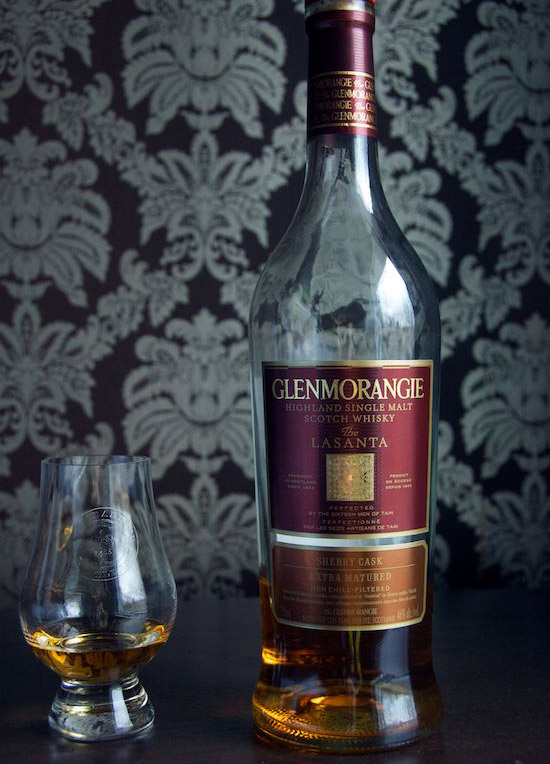
Glenmorangie - The LaSanta

Glenmorangie, a distillery dating back to the mid-1800s, holds the title for consistently having the best selling Scotch in Scotland (the Glenmorangie Original). Their proposition is unique:  first, the water they use is a mineral rich hard water from the Tarlogie Springs, unusual as most whisky makers use soft water.

Second, they favour American oak and actually own a forest in the northern part of Kentucky for use in their barrels (after which they use the barrels to make Kentucky bourbon).

After being purchased by the French company Moët Hennessy Louis Vuitton in 2004, Glenmorangie was repositioned as a more luxury brand, most evident via the naming of their Scotches:  Nectar D’Or Scotch, Sonnalta PX, LaSanta Highland, The Quinta Ruban. The curved bottles also help distinguish the brand versus their competitors.

The LCBO offers a fine selection of Glenmorangie Scotch starting at just over $60 and up to $100. I selected the LaSanta Highland Malt as it was aged in American oak and finished in a Spanish Sherry Cask, which promised enough sweetness that it could be drunk as a dessert Scotch.  I wasn’t disappointed, although my initial impression was that it was too sweet.  Over the next few occasions, the sweetness mellowed on my pallet and I began tasting the greater complexity present.

On the nose there’s a fine scent of honey, dried fruits, and woody oak. It’s a very promising start, suggesting a smooth finish. The pallet matches the nose, though the flavours explode where on the nose they’re mild. The honey sweetness hits you first and then the dried fruit finish, with hints of toffee, follows.  Some might find this Scotch too sweet at first (as I did), but the warming bite of the alcohol is still very much present. The woodiness comes through from start to finish, and you’ll have a nice lingering taste before you enjoy your next sip.

Out of the Scotches selected thus far, Glenmorangie is definitely sweeter and without detectable peat. Its rich colour sits well in a glass, and the flavours are plentiful.  Having had other Scotches from Glenmorangie in the past, I would say that you really can’t go wrong with a purchase from this distillery. It’s also a good gift idea.

Note: Originally published on Spotlight Toronto

Balvenie Caribbean Cask 14 Year Old

Not enough is said about whisky bottles, and Balvenie bottles deserve special mention. These bottles are fantastic, and not for innovation, but rather for their classic look. These bottles are the kind that you proudly inch forward on the booze shelf, the kind that you enjoy poring because the shape and heft in your hand. They’re also practical, designed with a short but wide rim in order to decrease the amount of drip.

Balvenie comes with great pedigree. In the early 1800s, William Grant & Sons (the owners of Glenfiddich) were looking to expand their operation and opened Balvenie. It’s one of the few family-run distilleries left in Scotland and they pride themselves on producing Scotch the traditional way. Most of the processes are done on-premise and by hand, a rarity these days in mass-produced whisky. They grow their own barley and rely on coopers for artisanal barrels. David Steward, long time William Grant & Sons Malt Master, is now solely focusing his attention on Balvenie during his semi-retirement. Stewart is largely credited for being among the first to do ‘cask’ finishes; that is, a process by which a traditional Scotch is aged in bourbon or sherry casks and then finished in a different cask to add more flavour.

The Balvenie Caribbean Cask
After 15 years of regular aging, this Balvenie Scotch was finished in a cask that previously held about 50 types of David Stewart’s choice rums. The intention was to imbue the Scotch with the rum’s buttery sweetness without making it overpowering. I’ve had this Scotch on two different occasions before writing this article and enjoyed it greatly each time.

The nose is only slightly sharp, with light tropical fruits and citrus. It’s a very vibrant, perky Scotch, both on the nose and on the pallet.  That sharpness comes with a juicy sweetness, vanilla, and what best can be described as orange zest. On the finish there’s a more tropical dried fruit finish. I would consider this Scotch a mellow well rounded drink with a shorter finish that leaves you wanting for more. The buttery sweetness of the rum is apparent, but this is certainly a Scotch with the bolder flavours one would expect. It’s a fantastic treat and I’ll be saving this one for special occasions.

The Caribbean Cask is available at the LCBO for a limited time at just under $100, and while this would be a great addition to a whisky cabinet, you could easily opt for any of the other Balvenie products: The 12 year old Doublewood is only $65 and has a very loyal following, and on the higher end, Balvenie also has a 21 year old Portwood Scotch for about $215.

Originally published on Spotlight Toronto

Food and Whisky Pairing Menu at Canoe

This past week, the team over at Canoe, including John Horne (chef de cuisine) and Will Predhomme (sommelier) accepted the challenge of creating a pairing menu for the Whisky enthusiast. Pairing food with wine is a more subtle art, and to be fair, this challenge was akin to asking the team to bring a Howitzer to a duel. I was extremely excited to taste what the team would put together.


1st course: “All Canada”
The first course was all about Canada: a sockeye salmon duo paired with Canada’s only single malt distillery, Glen Breton. The whisky acted as a blank canvas for the food, which had varied flavours between the maple cured salmon, salmon tartar, and the sides of sea asparagus, radish puree, and preserved lemon. The flavours of the plate accentuated elements of the whisky. For example, the slight smokiness of the Glen Breton added another dimension to the maple cure. The fattiness of the tartar balanced the whisky and encouraged a longer, sweeter finish than it has on its own.


2nd course: Frog legs with Irish whisky
Jameson 18 is a wonderfully smooth, mildly spicy whisky with a lingering sweet finish.  This dish is an example of the difficulties in pairing whisky. My first taste consisted of just the frog legs (sans accouterments) followed by a sip of the Jameson. Something was a bit off with this combination. The frog legs were beautifully glazed in three types of tree syrups with such a wonderfully smooth taste profile that the blunt force of the  whisky cut into it. However, once I added to the mixture the marinated eggplant that had a hint of bitterness, the brilliance of the pairing was quickly evident.  The initial overpowering flavour of the whisky was mellowed by the eggplant, allowing more “pop” in the gentle sweetness of the frog legs, with the bitter finish of the eggplant complimented by the sweetness of the whisky. A very good whisky lingers in a pleasant aftertaste, and this combination of sweetness and bitterness accentuated those lingering flavours. I couldn’t get enough of this pairing.


3rd course: Campfire Hen’s Egg with Lagavulin 16
My one fear when my wife suggested this challenge was that some Scotches are so beautifully complex on their own that the food would just get in the way. Lavavulin’s 16 year old is probably my favourite Scotch, so when I saw it on the menu I was concerned it would negatively impact both the food and the taste of the Scotch. Chef John Horne didn’t know about my love for Lagavulin 16, but he paired this smoky Scotch with my favourite course of the evening: Campfire Hen’s Egg. The egg was partially cooked in water leaving the yoke soft, stripped of the shell, and then finished in double smoked bacon broth. This gave the outside of the egg a beautiful golden colour with a smoky first bite, melting into a soft runny egg within. Accompanying the egg was a root vegetable slaw, prosciutto and smear of mustard, all lending and elevating to the rich earthiness of the dish. If you never had a Lagavulin, I’ll simply describe it as a Scotch that is heavily smoked. The smokiness is less that of a smoked fish, and more like a smouldering campfire. With the smokiness from the bacon broth, the Lagavulin provided a depth to the smokiness without overpowering the delicate flavours of the egg. The pairing of Scotch and prosciutto was worded on the menu as an “ambrosial accompaniment.” There are no disagreements here! The earthiness of the Scotch came through, as did the sweetness and saltiness of the prosciutto, enhancing the iodine tones. Given the boldness of the Lagavulin, one may assume that it would take center-stage, drowning out the flavors of the food it was paired it. But the kitchen, in their brilliance, managed to create a dish that held its own against the Lagavulin, and the flavours of both were elevated by this combination.

4th course: Maple & Miso Glazed Sablefish with Glenrothes ’98
Glenrothes ’98 is a beautifully bold Scotch. It’s filled with bright tropical fruit (tangerine, pineapple, lemon), honey, nutty and chocolaty tones. It was gutsy to pair this Scotch with such a delicate fish. The Sablefish was wonderfully fatty and sweet with the maple & miso glaze. The pairing added a zest to the fish, and the fattiness of the fish added greater depth to the Scotch.


5th course: Dessert & Woodford Reserve Bourbon
The complexity of bourbon hits you straight out of the gate, as opposed to Scotch which tends to linger from start to finish.  The dessert itself was a stone ground conrmeal cake with Ontario maple syrup (on the side) & oatmeal ice cream, and the combination could not have been more perfect. I’ll say that both bourbon and dessert were fantastic on their own. Together, they were incredible. The toasted corn flavour of both bourbon and cornmeal cake bursts right through, with flavours reminiscent of kettle corn. Even my wife, who does not typically like Whisky, fell in love with this pairing, proclaiming that this dish alone made her into a Bourbon fan.

The tasting menu was $100, and the addition of the Scotch pairing was an incremental $50. If you’re interested in repeating the experience please call Canoe in advance and ask them if it’s available. The pours were just enough for you to enjoy the whisky without it making you stumble out of the restaurant. The tasting notes, prepared by Nicolas Busch, were well thought-out, thorough, and a pleasure to read. This was an excellent experience, and I hope that other restaurants will also be willing to rise to the challenge.


Tullibardine

I have an admitted soft spot for Tullibardine. I toured their distillery last year and sampled a wide variety of their single malt offerings. It wasn’t a Scotch that I fully appreciated at first, but I purchased a 1993 vintage which had been aged in muscatel barrels. It was sweet, nicely balanced with oak, and quickly became my favourite easy-drinking Scotch.

Sadly it wasn’t available at the LCBO at first. That changed earlier this year when the LCBO brought in the regular aged 1993 vintage as a limited release. At $65 this is a fantastic purchase, and it’s already almost entirely sold out.

I was pleasantly surprised when I had my first sip of this vintage. You’ll get a hit of alcohol on the nose, but the taste is surprisingly mild by comparison. On the palate you’ll get more of the zesty flavour with a bitter finish, almost like that of a not-quite-ripe green grape (though not nearly as sweet). The after-taste is pleasant and mellow.

Tullibardine has an interesting history. The distillery was largely closed down in the 1990s and it moved quickly between a few buyers. These latest releases are from their old barrels (distilled by previous owners but left on-premise) that have been well aged. Their primary business is small-lot exports, and they’re not as well known within Scotland relative to other distilleries. Tullibardine Scotches offers a fantastic value, considering the evolved and multi-layer flavours.

If you’re ever near the distillery in Perthsire, Scotland, I recommend you take the tour. And if you happen to pick me up a bottle of the muscatel 1993, I’d be extremely appreciative!

Note: Originally published on Spotlight Toronto

Lagavulin 12 Year Old

One of the oldest distilleries in Scotland, Lagavulin has a history dating back to the mid-1700s (although their ‘official’ opening date was 1816). Lagavulin doesn’t make affordable Scotches -  their standard 16 year old is $110 at the LCBO, and it goes up from there, although they have recently released a 200mL ‘trial’ size of their 16 year old for $33.95.

A new LCBO entrant in the Lagavulin line is a limited quantity 12 year old cask strength Scotch. There are still some bottles available but the product is listed as discontinued so don’t expect to see it again until perhaps next year. Lagavulin has been releasing these Scotches annually since the early 2000s and judging from the reviews, they keep getting better each year.  My recent preference for cask strength Scotches made this an easy pick for the Whisky Cabinet.

As with all peaty Scotches, the first scent is smoke. It’s not Laphroaig smoky, but a more composed and complex earthy smokiness such as that of a nearby fire (whereas with Laphroaig, you are standing in the fire). That smokiness is joined with caramel, citrus, and an almost imperceptible hint of lavender. On the pallet I find this Scotch a perfect balance between the common taste profiles of salty, sweet, and the smoky. There’s a depth to every element, like that of a richly delicious meal. The after-taste is warm, with the smokiness slowly drifting away. Whereas some Scotches at this age have a heavy dried fruit sweetness, the Lagavulin has a softer, less imposing sweetness.

When drinking this Scotch, it really is about the second and third taste, as the initial hit might be too explosive in both peat and alcohol to fully appreciate. Give it a chance, let it warm up, and then enjoy. At around $115 at the LCBO it’s not inexpensive. If it’s too late to purchase this Scotch at your local LCBO, the 16 year old should be readily available and is an excellent option.

Note: Originally published on Spotlight Toronto

Laphroaig Quarter Cask

An ounce of just-poured Laphroaig Quarter Cask sits beside me as I write this, and already the smokiness wafts upwards. This is a Scotch for a more advanced drinker for a few reasons; but only because of its heavy peat and blasting character. 

Once you check the aroma a few times the smokiness will fade as you become accustomed to it, and you’ll certainly pick up the stronger alcohol content. The nose has been described as earthy, salty, and there’s definitely very little sweetness to it. You know you’re in for a ride before even taking the first taste.

The strength of the scent is deceptive, although the alcohol is definitely apparent. I believe the proper term for this type of whisky would be ‘warm’ and it certainly will warm you up almost immediately. With each sip the complexity increases as the flavours mellow, and sweeter, earthier qualities begin to emerge.

The quarter cask Scotch is produced in casks that are quarter the size of the standard, which allows the oak to really come through. If you like oaky wines or Scotches, you will likely appreciate this one. Although the Scotch is aged well under 10 years, the smaller cask size allows for more surface contact with the cask. So while it is not aged as long, it will have the oak flavour consistent with an older Scotch with less alcohol evaporating (alcohol evaporates as whisky ages in barrels).

Laphroaig is a major producer of Scotch with a history going back to the 1800s. They have several offerings in the LCBO ranging from the $60 range (as is this one) to the $600+ range for their 25 year old single malt. The 10 year old Laphroaig Scotch is the best selling smoky Scotch in the world, and also a good purchase. I’ve yet to try the 18 year old Scotch, but it’s definitely on my list of drinks to have.

Note: Originally published on Spotlight Toronto